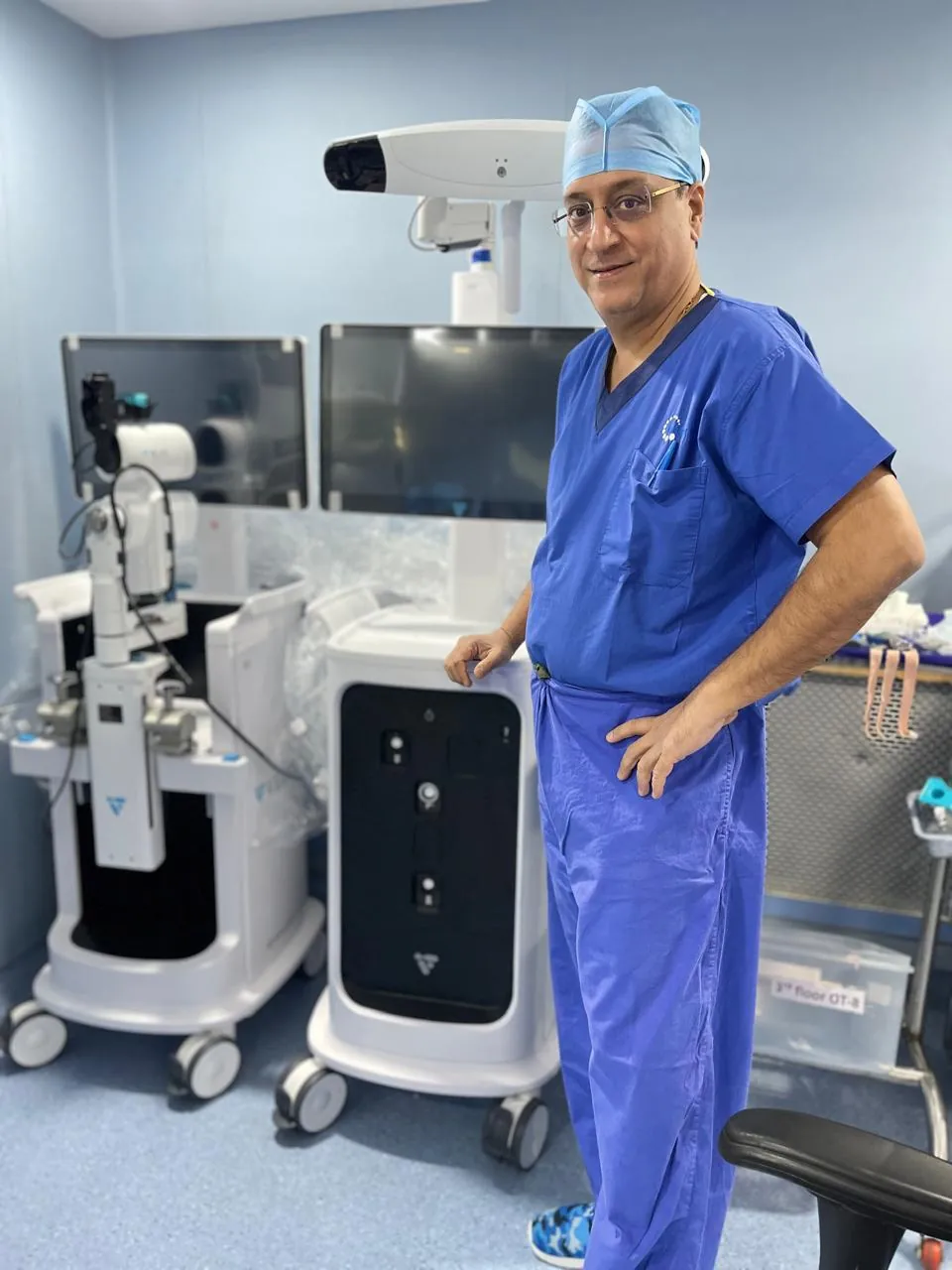
Robotic knee replacement in Mumbai is performed by Dr. Vinay S. Joshi at Kokilaben Dhirubhai Ambani Hospital using the VELYS Robotic-Assisted Solution from DePuy Synthes. Unlike older robotic platforms, VELYS requires no pre-operative CT scan — it maps the patient's bone anatomy live during the operation using optical tracking, then guides every bone cut with continuous feedback and automatic correction.
The word "robotic" causes more confusion than any other term in joint replacement. Patients picture a machine operating on them unsupervised. That is not what happens, and it is worth being precise about what the technology does and does not do before considering whether it is right for you.
What robotic-assisted surgery actually means
The robot does not perform the operation. Dr. Joshi performs the operation. The robotic system is an instrument — one that measures continuously, tracks the position of the bone in real time, and physically prevents a cut from straying outside the plan.
The most useful analogy is satellite navigation. It does not drive the car. It does ensure that every turn is exactly where it was meant to be, and it tells you immediately when you have drifted. The judgement, the plan and the execution remain the surgeon's.
The quality of a robotic knee replacement still depends almost entirely on the surgeon: on the soft-tissue release, the implant selection, the surgical approach and the rehabilitation plan. The technology amplifies expertise. It cannot substitute for it — which is why the operating surgeon's experience remains the single most important variable, robot or no robot.
The problem robotic assistance is solving
Even in expert hands, conventional knee replacement relies on manual measurement, handheld cutting jigs and the surgeon's eye for alignment. Published studies consistently show that 20–30% of conventionally placed implants end up outside the optimal alignment zone.
That matters because alignment compounds. A knee takes something in the order of a million loading cycles a year. A component sitting two or three degrees off target does not fail on day one — it wears asymmetrically, loads the polyethylene unevenly, and shortens the working life of the implant. Malalignment is the leading driver of early failure and of the revision surgery that follows.
Why no pre-operative CT scan is needed
This is the single biggest practical difference between VELYS and the earlier generation of robotic platforms, and it is the point most patients ask about.
Older robotic systems required a CT scan of the knee weeks before surgery, from which a 3D model was built and the plan constructed. That meant an extra appointment, an extra cost, and a meaningful dose of radiation — and the model was, by definition, a snapshot of the knee at rest rather than the knee as it behaves under surgical conditions.
VELYS works differently. At the start of the operation, optical tracking arrays are attached temporarily to the femur and the tibia. The system then maps the actual bone anatomy in theatre, building a live three-dimensional model during the procedure itself. That map updates continuously as the operation proceeds.
- No extra appointment — standard weight-bearing X-rays are all that is required beforehand.
- No CT radiation dose — relevant for every patient, and particularly for younger ones.
- No scan cost — removed from the overall package.
- A live model rather than a historical one — the anatomy the system works from is the anatomy in front of the surgeon.
How a robotic knee replacement is performed, step by step
1. Consultation and assessment
Dr. Joshi reviews your standard X-rays, examines the knee, assesses your deformity and ligament state, and discusses your lifestyle expectations — including whether you need deep flexion for floor sitting or prayer. No CT scan is ordered.
2. Planning and implant selection
Implant size and alignment targets are set from your imaging and clinical assessment. This framework is what the intra-operative system will work to.
3. Intra-operative mapping
Optical arrays are fixed to the femur and tibia. The system registers the bone surfaces and builds the live 3D model, establishing the mechanical axis and the planned resection planes.
4. Robotic-guided bone preparation
Dr. Joshi makes the bone cuts using the robotic-assisted cutting guide, which repositions itself in real time to hold the planned angle, depth and orientation regardless of any movement of the limb. The system tracks bone position around 500 times per second and locks out cuts that would breach the plan — an active safety boundary rather than a passive guide.
5. Ligament balancing and trial reduction
Trial components are inserted and the knee taken through its full arc. The system quantifies medial and lateral ligament tension across that arc, so soft-tissue releases are made against measured data rather than feel alone. Balance is one of the strongest determinants of whether a knee ultimately feels natural.
6. Final implantation
The definitive components are fixed, the wound closed in layers and a compression dressing applied. Physiotherapy starts the following morning.
What the evidence shows
The evidence base for robotic-assisted knee replacement now includes randomised trials, systematic reviews and national registry data.
| Source | Finding |
|---|---|
| Journal of Bone & Joint Surgery (2022) | Randomised controlled trial of 112 patients: robotic TKR achieved coronal alignment within 3° in 96% of cases versus 71% conventional, with superior patient-reported outcomes at one and two years. |
| The Knee (2021) | Systematic review of 14 studies and 1,247 robotic TKR patients: significant improvements in alignment accuracy, satisfaction and short-term functional recovery, with no increase in complication rate. |
| Australian Orthopaedic Association National Joint Replacement Registry (2023) | Registry data on more than 23,000 robotic-assisted procedures: an 18% reduction in five-year revision rates compared with conventional TKR. |
Alongside alignment, the controlled cuts produce less thermal damage and micro-fracturing of surrounding bone, which translates into less early post-operative pain, lower analgesic requirement and a shorter stay. Intra-operative blood loss is also lower than with conventional technique.
Who is a good candidate
Robotic assistance is suitable for the large majority of patients who need a knee replacement at all. The benefit is greatest in four groups.
- Younger patients, typically under 65, who will load the implant for decades and for whom implant survival is the dominant consideration.
- Patients with significant deformity, where conventional alignment jigs are least reliable.
- Patients for whom a revision would be particularly difficult — poor bone stock, prior surgery, or medical comorbidity that makes a second major procedure hazardous.
- Patients who want the best available chance of a natural-feeling knee, since balance data drives the soft-tissue work.
The counterpoint is honest: an older patient with modest activity demands will get an excellent result from conventional surgery in experienced hands, and the marginal gain is smaller. The cost guide discusses where that trade-off sits financially.
Robotic surgery and deep flexion
Precision in bone preparation and measured ligament balancing both matter a great deal to patients who need to sit cross-legged, squat or kneel for prayer. Achieving reliable deep flexion depends on posterior condylar offset, posterior capsule management and balance through the full arc — all of which the system quantifies. See the high-flex knee replacement guide for how implant choice interacts with this.
Frequently Asked Questions

Consultant Orthopaedic & Joint Replacement Surgeon and lead of the Arthroplasty team at Kokilaben Dhirubhai Ambani Hospital, Mumbai. Twelve years of specialist training across five UK orthopaedic centres, with further fellowships in Canada, Italy, Singapore and the USA. More than 4,500 joint replacements performed.