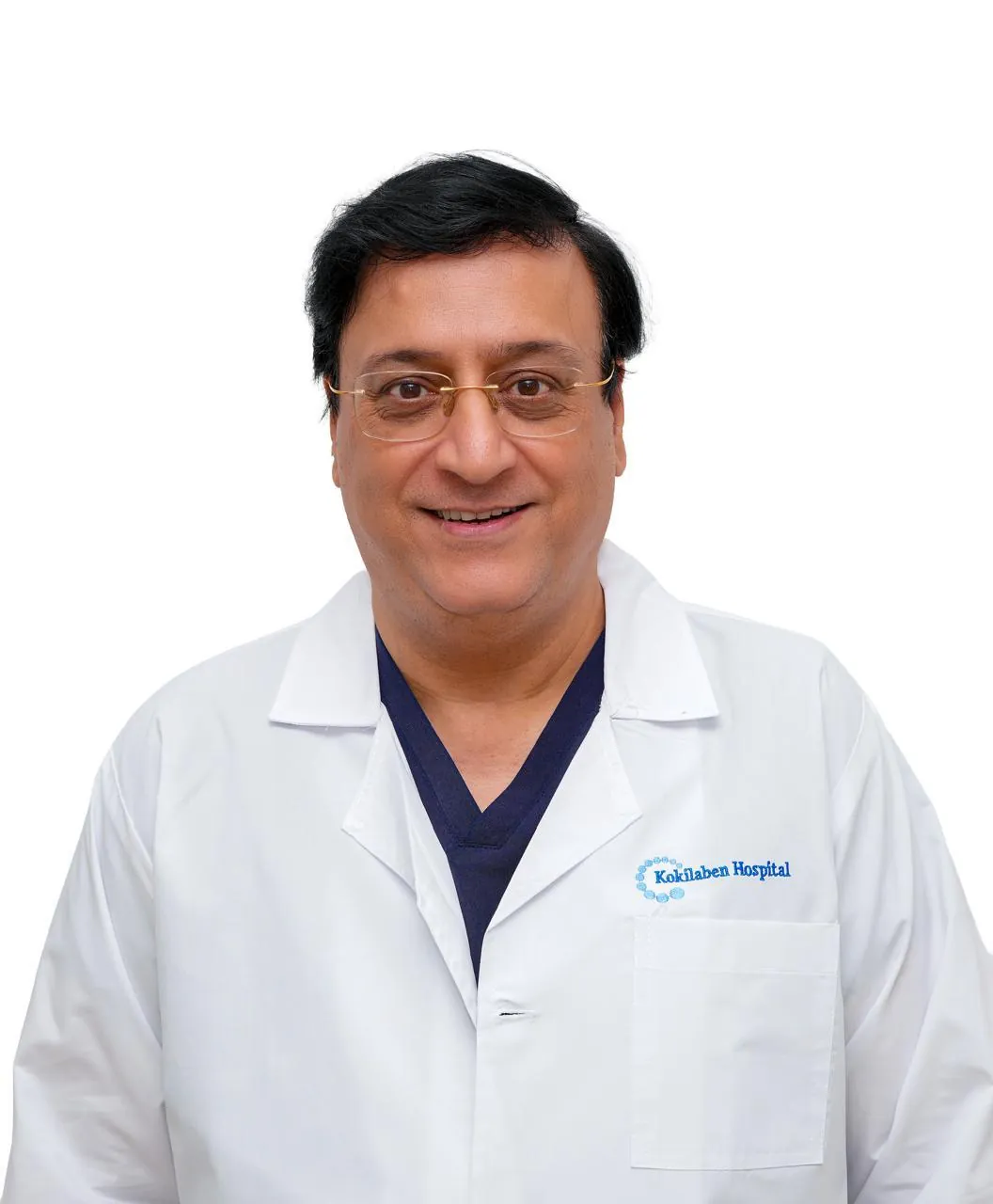
Clinical practice today
Dr. Joshi's practice is confined to hip and knee arthroplasty and divides broadly into three parts.
Primary joint replacement
Total and partial knee replacement and total hip replacement, performed through minimally invasive approaches with small incisions to support faster recovery. Implant selection is matched to the individual: Oxinium and high-flex knee systems for younger or deep-flexion patients, gender-specific components where female anatomy requires it, and ceramic-on-ceramic hip bearings — of which he has performed more than 100 — where implant longevity is the priority.
Robotic-assisted surgery
Dr. Joshi uses the VELYS Robotic-Assisted Solution from DePuy Synthes at Kokilaben Hospital, which was among the first centres in India to adopt the platform. VELYS requires no pre-operative CT scan, mapping the patient's anatomy live during surgery — a point he has presented on at the International Symposium on Robotic Joint Replacement.
Complex primary and revision arthroplasty
This is the part of the practice that other surgeons refer into: severe deformity, major bone loss, failed or infected implants, periprosthetic fracture, and patients who have been told their case is too difficult. It includes revision knee and revision hip reconstruction, two-stage revision for periprosthetic joint infection, and acetabular reconstruction for severe bone deficiency.
He also offers joint-preserving treatment for early-stage avascular necrosis of the hip — core decompression with cell-based Regrow therapy — which can avoid hip replacement altogether in patients diagnosed before the femoral head collapses.
Philosophy of care
Three principles run through the practice, and patients will encounter all of them at a first consultation.
Operate when it is warranted, and say so when it is not. A significant proportion of patients who come for an opinion are told that surgery is not yet needed, and that physiotherapy, weight management or a change in activity will serve them better for now. A surgeon who never declines to operate is not exercising judgement.
Ask how the patient actually lives. Whether someone sits cross-legged for meals, kneels for prayer, uses a floor-level toilet, travels for work or stands all day changes which implant is appropriate. These questions are frequently not asked, and patients rarely volunteer the answers — many assume floor sitting is simply lost after a knee replacement and never raise it. It determines implant choice, so Dr. Joshi raises it himself.
Set expectations honestly before the operation, not after. This matters most in revision surgery, where recovery is longer and the result generally does not match a well-performing primary replacement. Patients are told this plainly at consultation.
Teaching, research and conference work
Alongside clinical practice, Dr. Joshi contributes to the specialty through the postgraduate mentorship of orthopaedic surgeons, faculty teaching on cadaveric robotic courses, peer-reviewed publication, and conference presentation in India and abroad.
He teaches regularly on cadaveric robotic arthroplasty courses in Bangkok and Bangalore, where surgeons train on the robotic platform under supervision before using it in their own theatres.
He is a regular faculty member at ROC, the Ranawat Orthopaedic Course, which meets annually in Mumbai on advances in joint replacement — his case presentations on primary and complex total hip arthroplasty from ROC 2023 are published on the OrthoTV orthopaedic video channel. He also takes part in the debates at WIROC, the Western India Regional Orthopaedic Conference and annual meeting of the Bombay Orthopaedic Society.
Peer-reviewed publication
Where Dr. Joshi practises
Kokilaben Dhirubhai Ambani Hospital, Rao Saheb Achutrao Patwardhan Marg, Four Bungalows, Andheri West, Mumbai 400053. Outpatient consultations run Monday to Saturday, 9:00 AM to 5:00 PM. His hospital profile is published at kokilabenhospital.com.
The hospital provides laminar-flow theatres, full critical care and infectious diseases support, a joint replacement multidisciplinary team, and the VELYS robotic platform — the infrastructure that complex and revision arthroplasty depends on.