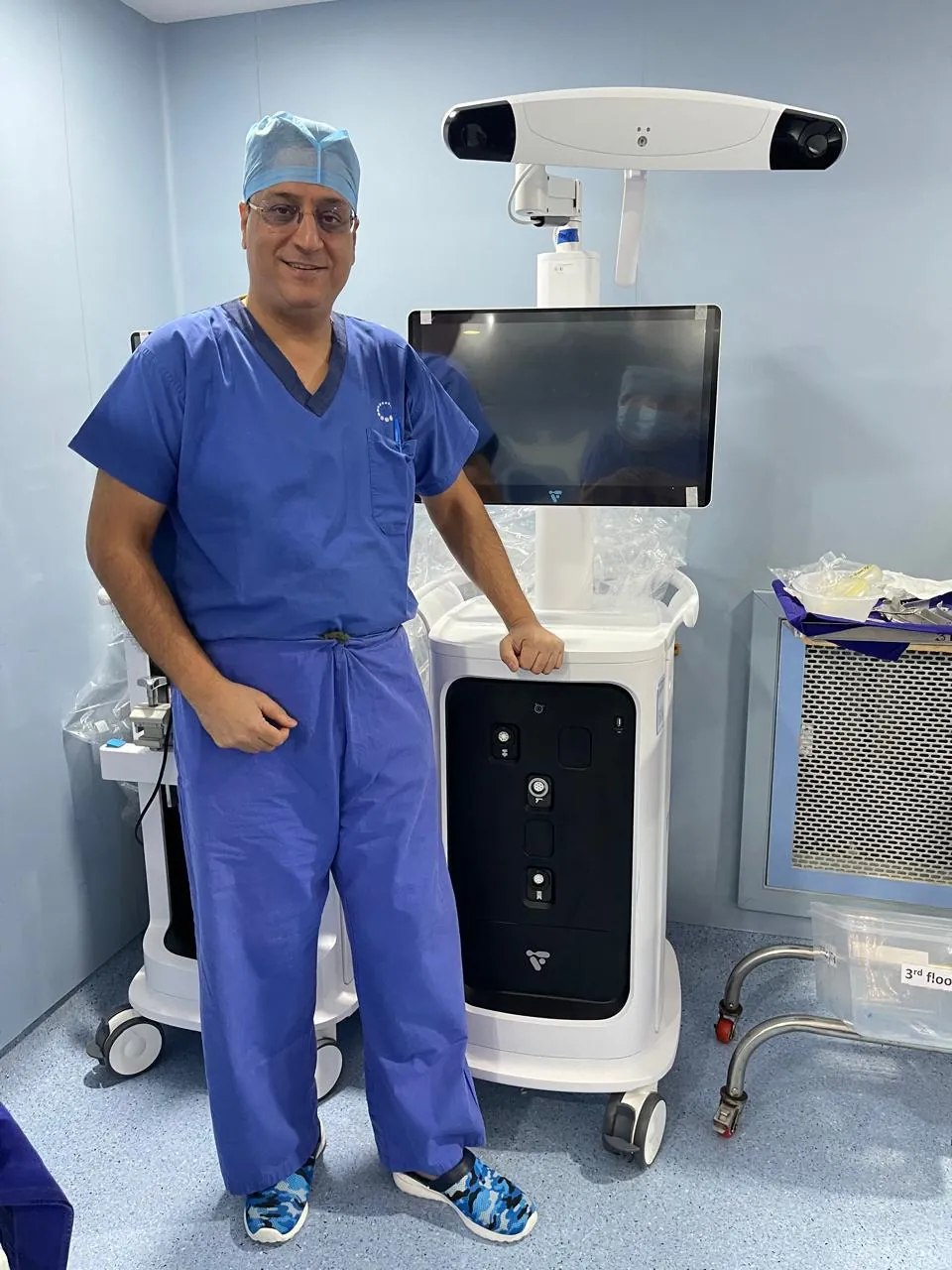
Revision total knee replacement is the removal of a failed knee prosthesis and its replacement with new components, usually alongside reconstruction of bone lost since the original operation. Dr. Vinay S. Joshi performs revision knee arthroplasty at Kokilaben Dhirubhai Ambani Hospital, Mumbai, including cases referred on by other surgeons as too complex.
It is among the most technically demanding procedures in orthopaedic surgery, and it is not simply a repeat of the first operation. The bone is compromised, the soft tissues are scarred, the cause of failure has to be identified with certainty, and the implants required are entirely different from primary components.
The first rule: never revise a knee without a diagnosis
This is the principle that governs everything else. A painful knee replacement is a symptom, not a diagnosis, and revising a knee without knowing why it hurts produces a patient with two failed operations rather than one.
A meaningful proportion of painful knee replacements are not failing at all — the pain is referred from the hip or the lumbar spine, or arises from an unrecognised infection, a complex regional pain syndrome, or extensor mechanism dysfunction. Dr. Joshi's workup is therefore deliberately exhaustive before any operation is contemplated.
Why knee replacements fail
Aseptic loosening
The commonest late cause. Polyethylene wear particles provoke an inflammatory response that resorbs the bone anchoring the implant — osteolysis — and the component gradually loosens. Typically presents as pain on weight-bearing, sometimes with a sensation of the knee shifting.
Periprosthetic joint infection
Either early, within weeks of the original surgery, or late, when bacteria reach the implant through the bloodstream from a dental procedure, skin infection or urinary infection. Late infection can be subtle — sometimes only unexplained persistent pain, without redness, swelling or fever.
Instability
The knee gives way or feels unreliable, usually from imbalanced soft tissues, incorrect component sizing or ligament failure. Revision typically requires a more constrained implant that supplies the stability the ligaments no longer can.
Stiffness and arthrofibrosis
Persistent restriction of movement, from excessive scar formation or from component malposition. Manipulation under anaesthetic or arthroscopic release may resolve it; where the cause is a malpositioned component, formal revision is required.
Periprosthetic fracture
A fracture of the femur, tibia or patella around an existing implant, usually after a fall. Often requires revision to a longer-stemmed component that bypasses the fracture.
Malposition and component failure
A component placed in poor position at the original surgery, polyethylene liner wear-through, or — rarely — fatigue fracture of a metal component.
How a revision is worked up
The thoroughness of the preparation, often taking weeks before any surgery, is the hallmark of specialist revision practice.
- Imaging — full-length weight-bearing radiographs for limb alignment, serial films compared against the immediate post-operative images to detect progressive lucency, and CT for three-dimensional mapping of bone loss and component rotation.
- Infection screening in every case — ESR, CRP, serum albumin, and joint aspiration with synovial fluid leucocyte count, differential and culture. This is done regardless of the apparent cause, because a positive aspiration changes the entire surgical strategy.
- Implant identification — obtaining the original operation record and implant details so the exact components in situ are known before surgery. This allows the correct extraction instruments and compatible modular parts to be sourced, and avoids intra-operative surprises.
- Nuclear medicine bone scan where infection or loosening remains uncertain.
- Multidisciplinary review — the KDAH joint replacement MDT, involving orthopaedics, anaesthesia, infectious diseases and haematology as relevant.
Performing a straightforward aseptic revision on a knee that is in fact quietly infected means the new implant becomes infected too. The patient then faces a two-stage revision they could have had from the start, after an unnecessary operation. Every revision candidate is screened.
The surgical challenge
Two problems define revision knee surgery. The first is removing well-fixed components without destroying the bone around them — which requires specialised extraction equipment and considerable patience. The second is that the bone left behind is deficient, and must be reconstructed before a new implant can be seated securely.
Bone loss is graded using the Anderson Orthopaedic Research Institute (AORI) classification, which drives the reconstruction plan. Depending on the defect, Dr. Joshi uses modular metal augments and wedges, porous metal cones or sleeves for larger contained defects, stems that bypass the deficient region to gain fixation in healthy diaphyseal bone, and structural allograft where the loss is severe.
Implant systems
Revision systems are modular by design. The degree of constraint is chosen according to the ligament state: a posterior-stabilised revision component where the collaterals are intact, a constrained condylar knee (CCK) where there is moderate instability, and a rotating hinge where the collateral ligaments are deficient or absent.
Two-stage revision for infection
When periprosthetic joint infection is confirmed, chronic infection is treated in two stages, which offers the highest eradication rate.
| Stage | What happens | Duration |
|---|---|---|
| Stage 1 | All implants and cement are removed, infected tissue is thoroughly debrided, and an antibiotic-loaded cement spacer is placed to deliver high local antibiotic concentrations. | 7–14 day admission |
| Interval | Intravenous then oral antibiotics, guided by culture and sensitivity, with inflammatory markers monitored until they normalise. | 6–12 weeks |
| Stage 2 | Once eradication is confirmed by markers and repeat aspiration, the definitive revision prosthesis is implanted in a clean field. | 5–10 day admission |
Where infection is diagnosed acutely — within roughly four to six weeks of the original surgery — DAIR (debridement, antibiotics and implant retention) may be attempted instead, exchanging the polyethylene liner and retaining the fixed components. It succeeds in 60–80% of cases when performed early.
Recovery: an honest account
Recovery from revision surgery is longer and more demanding than from a primary knee replacement, and Dr. Joshi discusses this frankly before proceeding rather than afterwards.
- Hospital stay — five to ten days for an aseptic revision, depending on the extent of reconstruction.
- Weight-bearing — many patients need four to six weeks of protected weight-bearing to allow graft or augments to integrate, reviewed with X-rays at six and twelve weeks.
- Functional recovery — six to twelve months for aseptic revision; twelve to eighteen months for a two-stage revision including the interval period.
- Outcome — the majority of patients achieve significant pain relief and functional improvement, but results generally do not match those of a well-performing primary replacement. Realistic goal-setting is part of the consent process.
If you have been told nothing can be done
Patients are sometimes told their case is too complex, too infected, or that they must simply live with a painful knee. Many such cases are manageable in a unit that performs revision work regularly. Dr. Joshi's twelve years of UK training included specialist experience at revision arthroplasty referral centres, and he offers specialist second-opinion consultations — including virtual consultations for patients outside Mumbai. Bring your original operation record and implant details if you have them. See also the complex and revision surgery page.
Frequently Asked Questions
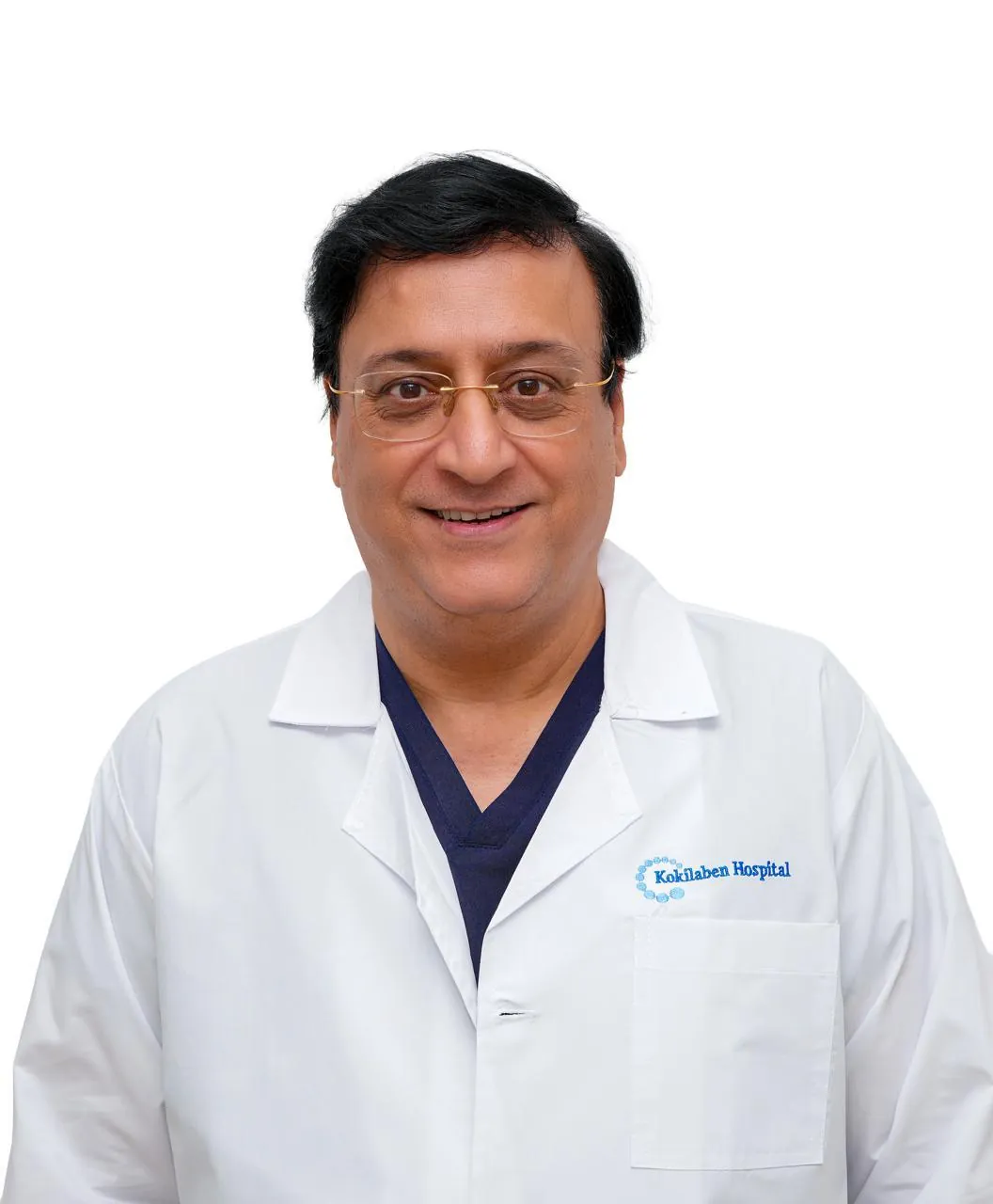
Consultant Orthopaedic & Joint Replacement Surgeon and lead of the Arthroplasty team at Kokilaben Dhirubhai Ambani Hospital, Mumbai. Twelve years of specialist training across five UK orthopaedic centres, with further fellowships in Canada, Italy, Singapore and the USA. More than 4,500 joint replacements performed.