There is no objective register of the "best" orthopaedic surgeon in Mumbai, and any surgeon who claims the title is telling you about their marketing rather than their results. What can be assessed are six things: sub-specialisation, case volume, fellowship training, revision capability, hospital infrastructure and how the surgeon handles the consultation itself.
This page sets out those six criteria, explains why each one matters, and — since you are reading it on his website — states plainly how Dr. Vinay S. Joshi measures against each. You should apply the same criteria to every surgeon you consider, including him.
1. Does the surgeon sub-specialise in joint replacement?
Orthopaedics is a wide field. A general orthopaedic surgeon may treat fractures, sports injuries, spinal problems, hand conditions and arthritis in the same week. That breadth is valuable in a district hospital; it is a disadvantage when what you need is one operation done exceptionally well.
Arthroplasty has become a sub-specialty in its own right precisely because implant systems, alignment philosophy, soft-tissue balancing and bearing selection have grown too detailed to keep current with as a sideline. Ask directly: what proportion of your practice is joint replacement?
Practises exclusively in primary and complex revision hip and knee replacement. He does not perform general orthopaedics, spinal surgery, sports injury surgery or trauma work. He leads the Arthroplasty team at Kokilaben Dhirubhai Ambani Hospital.
2. What is the surgeon's case volume?
Volume is the most consistently evidenced predictor of outcome in joint replacement. Across multiple national registries and health systems, higher-volume surgeons and higher-volume hospitals show lower rates of complication, dislocation, infection and early revision. The relationship is not subtle.
The reason is not merely manual practice. A surgeon operating frequently encounters the difficult variations often enough to have a considered plan for them, works with a theatre team that knows the routine, and gets faster — and shorter operating time correlates with lower infection risk.
Ask for a number, not an adjective. "Extensive experience" means nothing; "roughly 300 a year, of which about 40 are revisions" is an answer.
More than 4,500 joint replacements performed. His Kokilaben Dhirubhai Ambani Hospital profile records over 3,500 total knee replacements and over 1,000 total hip replacements, including more than 100 ceramic-on-ceramic hip replacements — among the higher volumes of that specialised procedure in India.
3. Where did the surgeon do fellowship training?
Basic orthopaedic training teaches the operation. Fellowship training — a dedicated period spent in a unit that does nothing else — teaches the judgement: which implant for which patient, how to handle the case that does not follow the textbook, and when not to operate at all.
Fellowships at established arthroplasty centres also expose a surgeon to failure. Seeing why implants fail, and repairing other surgeons' complications, changes how a surgeon performs primary surgery.
Trained in orthopaedics at Topiwala National Medical College & Nair Hospital, Mumbai. Twelve years in the United Kingdom with specialist joint replacement training at five different hospitals, and FRCS from the Royal College of Surgeons of England. Further international training in Canada, Italy, Singapore and the USA, including dedicated Attune knee system training in Canada and Singapore.
4. Does the surgeon perform revision surgery?
This criterion is the one patients most often overlook, and it is arguably the most revealing. A surgeon who performs revision arthroplasty has seen, in detail, every way a joint replacement can fail — and that knowledge shapes how they do primary surgery, particularly around bone preservation, component positioning and infection prevention.
It also determines what happens if something goes wrong with your own replacement. A surgeon who does not do revisions must refer you elsewhere. One who does can manage the whole course of your care.
Ask: if this implant fails in ten years, will you be the one revising it?
Performs complex primary and revision knee and hip arthroplasty, including two-stage revision for periprosthetic joint infection, acetabular and femoral reconstruction for bone loss, and cases referred on by other surgeons. His UK training included specialist experience at revision arthroplasty referral centres.
5. What does the hospital bring?
A joint replacement is a team procedure in a technical environment, and the surgeon is one part of it. The infrastructure around the operation matters more than most patients realise.
- Laminar-flow theatres and body-exhaust suits, which reduce deep infection risk.
- Anaesthetic and critical care support capable of managing patients with cardiac, renal or respiratory comorbidity.
- An in-house infectious diseases service and microbiology — essential if infection ever occurs.
- Inpatient physiotherapy from day one, not on request.
- Implant availability — a full range of sizes, constraint levels and revision components on the shelf, so the plan is not constrained by stock.
- Access to robotic technology, where indicated.
Operates at Kokilaben Dhirubhai Ambani Hospital, Andheri West — a tertiary hospital with laminar-flow theatres, full critical care and infectious diseases support, a joint replacement multidisciplinary team, and the VELYS robotic-assisted platform, which KDAH was among the first hospitals in India to adopt.
6. Is robotic capability available — and is it used honestly?
Robotic assistance measurably improves alignment accuracy and, in Australian registry data, reduces five-year revision rates by around 18%. It is worth having available. But the technology is also heavily marketed, and the sensible test is whether the surgeon can explain what it does and does not change — and whether they will tell you when it would make little difference in your case. See the robotic knee replacement guide for the detail.
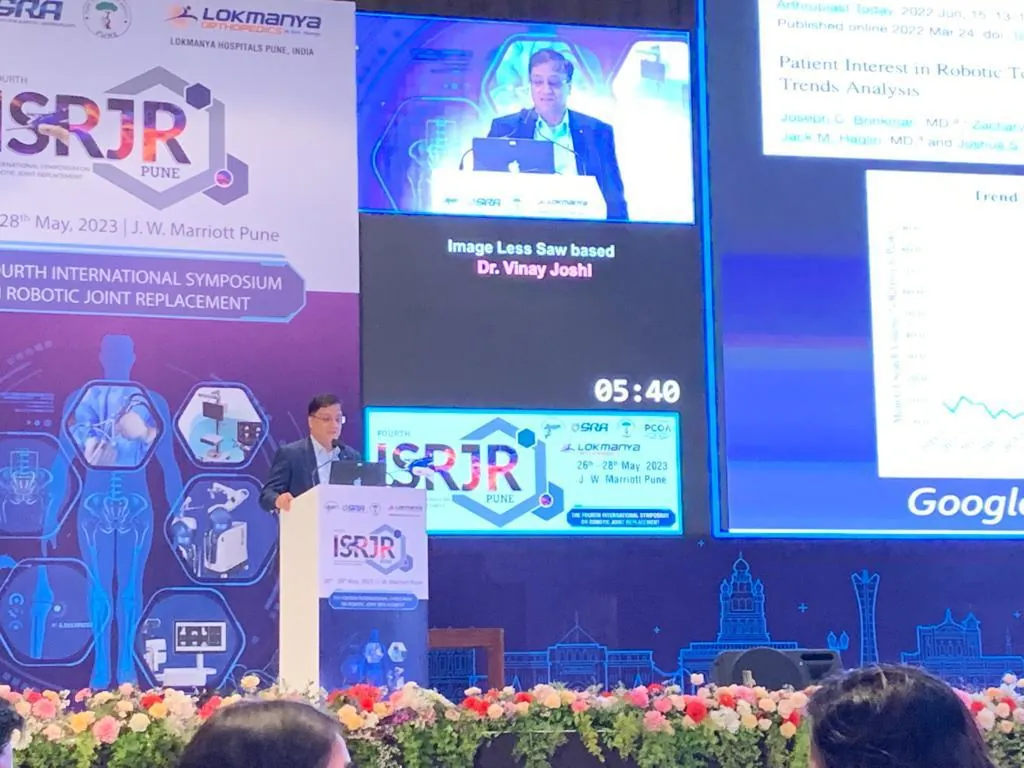
Uses the VELYS robotic-assisted platform, which requires no pre-operative CT scan and maps the knee live during surgery. He has presented on image-less, saw-based robotic knee replacement at the International Symposium on Robotic Joint Replacement, and advises against robotic assistance where it would not meaningfully change the result.
What the consultation itself tells you
After the credentials, the consultation is the most useful evidence you will get. Watch for these things.
- Does the surgeon examine you, or only look at the scan?
- Are non-surgical options discussed before surgery is proposed? A surgeon who never says "not yet" is worth a second thought.
- Are risks and complications explained specifically, including infection, clots, stiffness and the possibility of revision?
- Is the implant choice explained with a reason tied to your anatomy, age and lifestyle?
- Were you asked how you actually live — whether you sit on the floor, pray kneeling, squat, travel or work standing? This determines implant selection and is frequently not asked.
- Will the consultant operate personally, or will a member of the team perform the surgery?
- Do you get straight answers about cost, in writing, before admission?
Pressure to decide the same day · a promise of a specific outcome or a guarantee · dismissal of a second opinion · reluctance to give case numbers · an implant recommended without a clinical reason · no discussion of what happens if it fails.
On second opinions
Seeking a second opinion before major elective surgery is normal, sensible and expected. No good surgeon is offended by it, and any surgeon who discourages it has told you something important. Bring your X-rays, your operation records if you have had previous surgery, and your list of questions.
Where the marketing claims fit
You will encounter "India's best knee surgeon" and similar phrasing on many websites. These are advertising claims, not verifiable facts, and under the National Medical Commission's professional conduct standards, self-superlative advertising by registered practitioners is not permitted. Treat such claims as evidence about the practice's marketing rather than its results.
The verifiable things are the ones listed above: sub-specialisation, volume, training, revision capability, hospital infrastructure and consultation quality. They are also, conveniently, the things that actually determine how your knee or hip feels in ten years.
If you would like to apply these criteria to Dr. Joshi in person, consultations are available at Kokilaben Dhirubhai Ambani Hospital and by video for patients outside Mumbai. His hospital profile is published at kokilabenhospital.com, and patient reviews are on Google.
Frequently Asked Questions
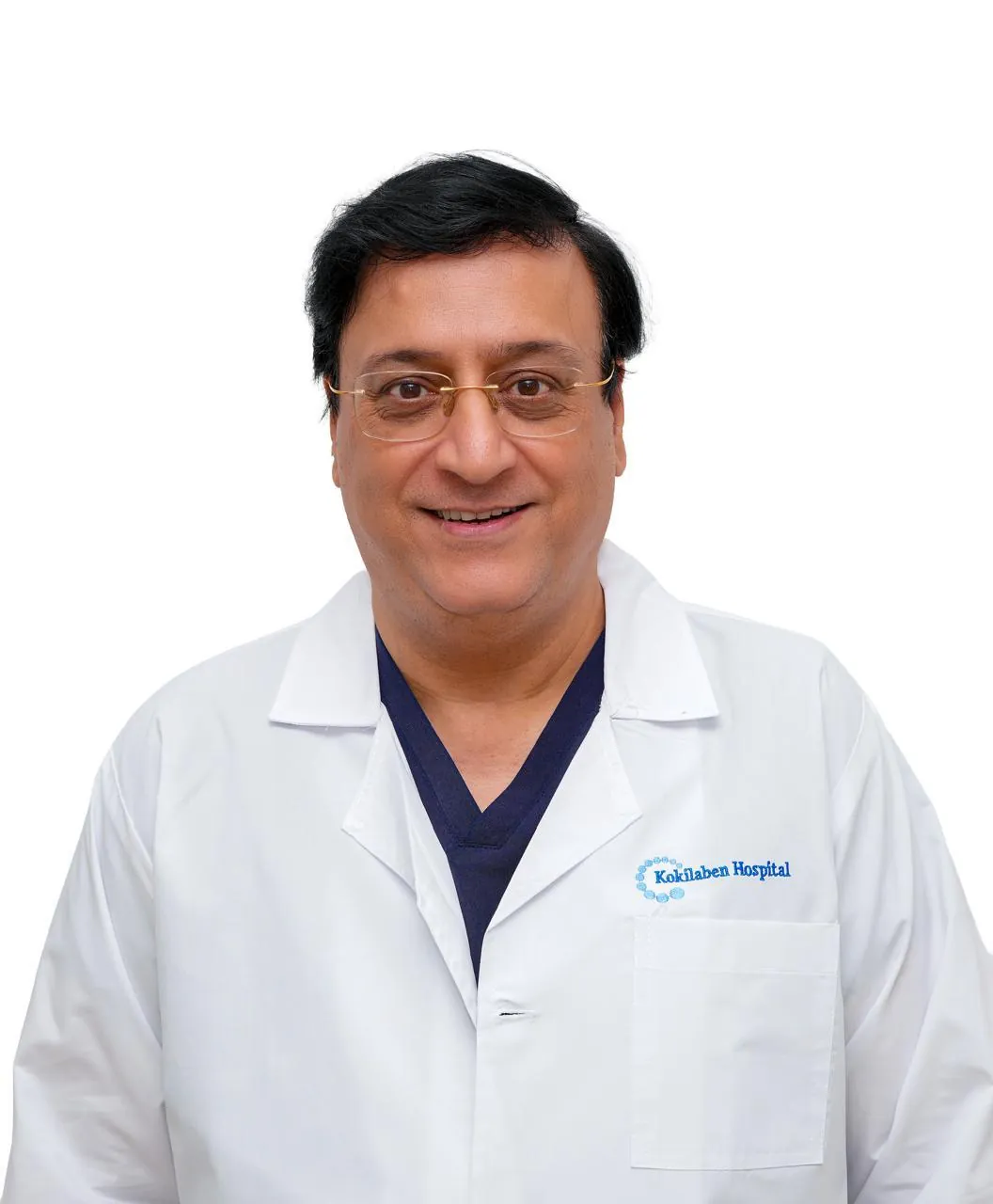
Consultant Orthopaedic & Joint Replacement Surgeon and lead of the Arthroplasty team at Kokilaben Dhirubhai Ambani Hospital, Mumbai. Twelve years of specialist training across five UK orthopaedic centres, with further fellowships in Canada, Italy, Singapore and the USA. More than 4,500 joint replacements performed.